|
Chapter 6: Buying A Vehicle
Section Introduction:
This chapter outlines how to negotiate from a power position
to pay the lowest price you can for a new vehicle. The knowledge
you have acquired gives the power to get a good deal but
knowing how to handle the negotiation can make the difference.
Part of this knowledge is an understanding of the salesperson's
strategies and pressures and these are explored here. If
you have gone through the other chapters, have the information
you need and are ready to buy, this is the chapter to read.
At the end of this chapter, "Buying your new vehicle",
describes the process you should follow when you actually
get down to business and talk to a dealership.
Good luck with your vehicle purchase!
 Be
well informed to negotiate from a power position Be
well informed to negotiate from a power position
As they say in Poker, "If you don't know who
the sucker is…it's you!" Do your homework to avoid
this. Knowledge will give you the power to be in control
of the negotiation. So, before you walk in to the dealership,
you should know the following.
- The dealers invoice price of the car you are interested
in. Bring in your information organized in a folder and
freely show it to the salespeople that you see. Do this
not only because they may not know the invoice price themselves,
but also because they will treat you more seriously if
they know that you know what you are talking about.
- The presence of any dealer holdbacks, incentives, customer
rebates or other special offers that can strengthen your
bargaining position. Consider these factors before setting
your points bidding target. Show that you are knowledgeable
and refer to these and you will establish the validity
and seriousness of your low offer.
- The availability or popularity of the vehicle itself,
its scarcity or oversupply. Be aware of the fact that
the salesperson has more pressure than you do. You can
take your money anywhere but they have a limited number
of customers on any given day and specific sales targets
to meet.
- Your points bidding target. How many percentage points
over the invoice price you are prepared to go and where
you want to start the bidding. Refer to chapter two of
this manual when deciding where you want to open the bidding,
what you are prepared to pay and what you will absolutely
not go beyond.
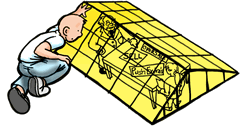 Be
aware of the sales strategies Be
aware of the sales strategies
The salesperson's first strategy is to evaluate you
as a buyer.
- Dress presentably. If your salesperson sees you
as a person who is definitely going to buy from someone,
he will feel more pressure to haggle.
- Keep the conversation on the vehicle at hand.
Don't answer personal questions about your plans for the
vehicle, your finances or yourself. The salesperson is
just trying to gauge your need for financing, your willingness
to accept add-ons and anything else that he can use to
add to his potential for profit.
The salesperson's second strategy will be to control the
context of the negotiation.
- Don't let them talk in terms of discount from
the MRSP. Your first goal is to get them to talk in terms
of cost over the invoice price.
- Don't allow the salesperson to bring rebates,
financing, special options and/or everything else into
the negotiation. Control the negotiation and focus on
the invoice price and your bid over that price.
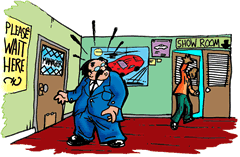 A
third sales strategy is the waiting game. A
third sales strategy is the waiting game.
- Stay on the move. Do not sit around in a waiting
area while the salesperson 'goes to talk to the manager'.
Instead, move around the shop looking at the other vehicles.
Let them be aware that you are quite prepared to move
on to the next dealership down the street and that you
want to buy soon.
- If they are constantly going the sales-manager
for consultation, ask to deal with the manager yourself.
Be in control and be prepared to walk away.
Guilt, the universal sales ploy.
- Don't feel compelled to buy because a salesperson
spends time with you. You know your price; if they want
your business they can accept yours or lose it to the
guy down the block. That's their call.
- They're not 'losing money on this deal'. A main
point of your research and preparation is that it allows
you to know how much they are making off your purchase
so that you can control that number. You know specifics
about their holdback percentage, invoice price, dealer
incentives, demand and supply. If they make $500 off your
purchase instead of $1500, they haven't lost $1,000; they've
still gained $500.
|
TIP: When dealers compete for your business -
You Save!
Compare dealer prices from multiple discount dealers
in your area using Edmunds.
With multiple price quotes you'll be able to get
the best deal on the vehicle you want.
It's the fast, easy and headache free way
to shop!
|
|
|
|










 Car Reviews



 Previous
 Next
Next

