|
Chapter 6: Buying A Vehicle (continued)
 Buying
your new vehicle-the process Buying
your new vehicle-the process
- Dress well and walk in with confidence. A salesperson
will approach you. Know the vehicle you are looking for,
the options package you want and be prepared with a folder
full of information and points target decided in advance.
The goal of this step is to have the salesperson recognize
you as a serious customer who knows what they want.
- Specify the vehicle, model, options package and price
over invoice that you have decided to open the bidding
with and don't let the topic shift. Make sure they know
that you know what you are talking about, show them your
information folder but don't reveal your actual points
target, ever. They'll know they've hit it when you accept
their counter-offer.
This will begin your strategy to control the context of
the negotiation. Keep the focus on the model and options
package you already have in mind. Don't let them blur
the issue by discussing monthly payments, switching options,
models and/or changing the subject to talk about you and
what you want. You know what you want to buy and what
you want to pay for it and have just told them. They are
just fishing for useful personal information.
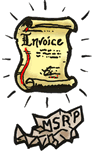 Get
the salesman talking in terms of price over invoice instead
of MRSP. This is an important step. It will be what you
know and it establishes your control over the negotiation.
Let them know you will be including the other factors,
like a customer rebate or a trade-in, after the price
over invoice is determined. Get
the salesman talking in terms of price over invoice instead
of MRSP. This is an important step. It will be what you
know and it establishes your control over the negotiation.
Let them know you will be including the other factors,
like a customer rebate or a trade-in, after the price
over invoice is determined.
This continues your strategy to control the context of
the negotiation. By keeping the focus on the elements
of the deal that you know about, you take away the salespersons
ability to work in profits you are unaware of.
- Don't wait around while the salesperson consults with
others. Give them your contact information and let them
know that they have a limited amount of time to accept
your offer because you are buying soon and will buy from
another dealer who is prepared to meet your price.
This will put pressure on the salesperson and, again,
maintains your control over the negotiation. Don't be
surprised when they come back and say the first offer
is too low.
- Counter their protestations that the price is to low
by returning to the information you have at hand. Let
them know the invoice price, the holdback, the demand
and so on. Tell them the profit they are making on your
offer with everything factored-in, let them know you are
not prepared to give them more than that.
This will re-affirm your position of knowledge. At this
point you will likely be talking with a sales-manager
or the salesperson will be aware of his limits from the
consultations he will have had on your behalf. They should
counter-offer at this point.
- Don't make any bids after the first one. It is tempting
to say 'meet me halfway and we'll talk', especially when
the halfway mark is your real target, but this is a mistake.
Tell them, "No thanks, it is still a little too high."
until they offer close enough to or meet your real target.
- Don't jump at the deal if they do meet your price target!
Take a day to check your figures and make sure that this
is the vehicle you want. Say you'll get back to them within
a couple of days and let them know where to contact you
if they decide to go down to your opening bid.
Now you have what you need to talk to other dealerships:
a firm price from a competitor.
- Phone or visit a few more dealers and see if you can
improve on your firm price.
If the vehicle you've chosen is over-supplied, or you
find a dealer with a particular need to move wheels off
the lot, you may get an even better deal than you had
planned.
- If you've got the deal you want, the car you want and
the options you want, it is time to see the finance manager.
Make sure that you get any customer rebates, full trade-in
value for your existing vehicle and any other special
offers that may apply to you.
Don't allow your negotiation to go bad at this point by
signing a bad deal with the finance manager. It is probably
simpler and cheaper to arrange financing through a bank
or credit union but check on the dealership's financing
offer just in case it is better. Remember though, low
monthly payments usually mean a higher total price in
the end.
 Do
the math yourself. Use a calculator and add up the following: Do
the math yourself. Use a calculator and add up the following:
price-over-invoice + applicable-customer-rebates = taxable
price.
taxable-price + sales-taxes + freight-charge + dealer-advertising-fee
= Total Cost
Total Cost is the total amount you should pay for the
vehicle. Don't pay any additional amounts without adequate
explanations for them.
Congratulations on your new vehicle!
|
TIP: When dealers compete for your business -
You Save!
Compare dealer prices from multiple discount dealers
in your area using Edmunds.
With multiple price quotes you'll be able to get
the best deal on the vehicle you want.
It's the fast, easy and headache free way
to shop!
|
|
|
|










 Car Reviews



 Previous
 Next
Next

